

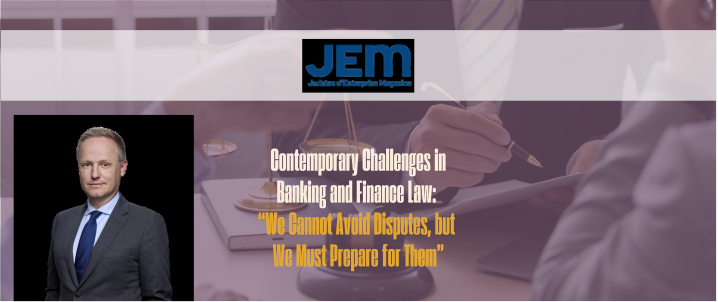
Contemporary Challenges in Banking and Finance Law: “We Cannot Avoid Disputes, but We Must Prepare for Them”
Interview with Nicolas Thieltgen, Managing Partner and Founding Partner of Brucher Thieltgen & Partners
Nicolas Thieltgen is one of the founding partners of Brucher Thieltgen & Partners. Specialising in banking and finance law, he is recognised for his expertise in handling complex disputes in this field. In this interview, he discusses the key challenges involved in managing banking and financial disputes.
As a specialist in banking and finance law, what are the main issues currently facing your clients?
Between 2008 and 2022, banks had to adapt to a significantly evolving legal framework. Today, banking activities are subject to much stricter regulation than in the past. The banking sector is now better regulated and, hopefully, safer.
However, this process is far from complete. Luxembourg’s banking sector has recently spent several months implementing ESG regulations, with Luxembourg positioning itself as a leader in sustainable finance. We are only now beginning to see the practical operational consequences of PSD2. The DORA regulatory framework, the Artificial Intelligence Act and, more broadly, technological developments are also major concerns for financial institutions, particularly given the significant volumes of data processed by these organisations.
What are the implications of increasingly stringent regulations in the financial sector?
We are seeing better organisation and, above all, greater transparency among financial institutions.
Beyond that, although DORA, the AI Act, PSD2 and ESG regulations impose significantly more obligations on banks, I do not believe that these new rules will immediately increase the risk of litigation initiated by their clients.
However, the risk of regulatory proceedings has increased, as supervisory authorities are responsible for monitoring compliance with these regulations and will therefore play a much more active role.
How can disputes be prevented?
It is undoubtedly impossible to prevent every dispute, but organisations can prepare for them in order to minimise their potential impact.
The first priority is to establish excellent document management practices within the organisation. It is essential to be able to retrieve the information at the heart of a dispute.
The second priority is to have an effective and clearly defined dispute management process in place before a dispute arises. In a crisis situation, when litigation becomes a reality, responsibilities must be clearly allocated within the organisation.
Who manages the dispute? Who determines the strategy? The CEO, the legal department or the board of directors?
Finally, it is essential to work with professionals capable of assessing the risks of potential litigation. In this respect, companies should seek advisers who understand their organisational structure, particularly a law firm capable of adapting to their specific profile and needs.
What expertise and support does your firm provide?
At Brucher Thieltgen & Partners, we are fortunate to combine strong technical expertise in banking and finance law with extensive experience in dispute resolution, two areas that frequently overlap.
When a dispute arises, we adopt a project management approach, ensuring an optimal allocation of responsibilities.
Through continuous monitoring, regular communication and transparency in the handling of each matter, we enable our clients to maintain a clear understanding of their case and the associated risks.
Nicolas Thieltgen, Managing Partner : nicolas.thieltgen@btplawyers.lu