

How to Recover Outstanding Debts from Your Debtors?
Unpaid invoices, missed payment deadlines: any company may one day face difficulties recovering outstanding debts. What should a business do when it is owed money, sometimes a substantial amount? What legal or amicable steps can be taken to recover these sums?
Debt recovery refers to any amicable or judicial means used by a creditor to obtain payment of an outstanding debt from a debtor.
“Debt recovery is a major concern for businesses, particularly given the difficulties experienced during the Covid-19 crisis. The need for liquidity is greater than ever, and recovering outstanding debts quickly has become a priority for companies,” explains Gladys Giudici, Senior Associate at Brucher Thieltgen & Partners.
Anticipating Potential Payment Issues
Fortunately, business leaders can take preventive measures to anticipate such situations.
Companies can discourage late payments by introducing contractual mechanisms applicable in the event of non-payment, as well as specific payment arrangements, such as advance payments.
It is also advisable to exercise caution before entering into any contract by verifying the debtor’s solvency.
A Multi-Step Procedure
“Despite the precautions taken, debt recovery proceedings may sometimes become unavoidable. Business managers must adopt a firm approach towards debtors to prevent late payments or non-payment from becoming recurring issues.”
The starting point of any recovery procedure is the identification of a payment delay, meaning that the deadline initially established by the contract or by law has been exceeded.
For commercial debts between two companies, this period is generally 60 days.
“The company or its lawyer may send a formal notice of payment to the debtor. This notice must be sent by registered letter with acknowledgement of receipt to the registered office address listed in the Luxembourg Trade and Companies Register. It must also include essential information: the exact amount owed, the contractual documents on which the claim is based, the deadline granted for payment and, where applicable, the possibility of terminating the contract.”
Both parties may also reach an amicable settlement, provided that the debtor is willing to cooperate and agrees to establish a payment schedule.
“If the debtor fails to pay the outstanding amount, the creditor company may bring proceedings before the competent courts. The first step is to determine whether the contract contains a valid jurisdiction clause specifying the court with territorial jurisdiction.”
Both territorial and subject-matter jurisdiction must be taken into consideration.
Territorial jurisdiction generally depends on the registered office of the defendant.
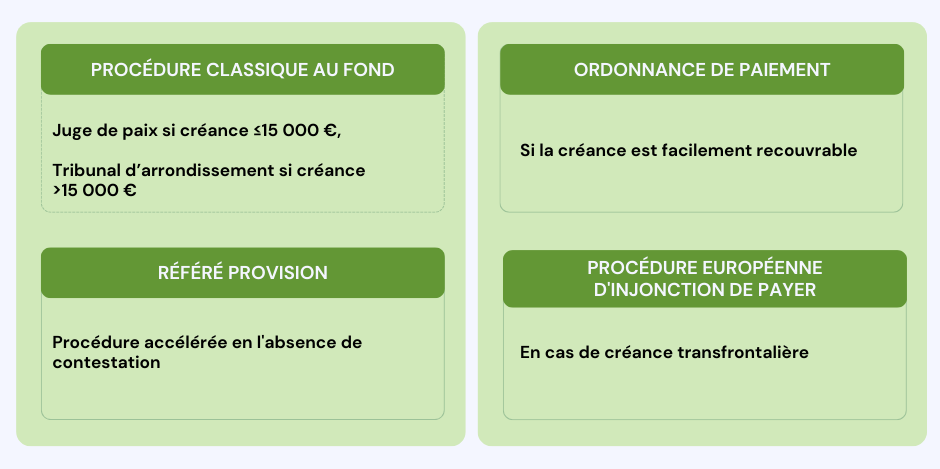
Subject-matter jurisdiction, meanwhile, is determined by the amount of the claim. The Justice of the Peace has jurisdiction over claims of EUR 15,000 or less, while claims exceeding this amount fall within the jurisdiction of the District Court.
“In addition to these ordinary proceedings, Luxembourg provides other legal remedies, such as the payment order procedure for straightforward debt claims, interim payment proceedings (référé-provision), which offer an expedited procedure where there is no serious dispute, and the European Order for Payment procedure for cross-border claims.”
When seeking to recover debts, creditors may rely on the principle of the accepted invoice, which facilitates proof of a claim where the dispute involves two commercial parties, such as two companies.
“A commercial party that fails to dispute an invoice within a short period after receiving it is presumed to have accepted it and must therefore pay it.
This is a particularly useful means of evidence because, when the court applies this principle, the invoice is presumed to have been accepted by the debtor, who can only rebut this presumption by proving that they contested it in due time. The burden of proof is therefore reversed.”
Legal Proceedings for Debt Recovery
Potential Additional Compensation
In addition to recovering the principal amount owed, businesses may also claim late payment interest from the debtor.
They may request statutory late payment interest, for which the applicable rate at the time of the article was stated as 10.5%.
Creditors may also claim fixed compensation of EUR 40 per invoice to cover recovery costs, as well as reimbursement of part of their legal fees.
Additional damages may also be claimed where the requirements for contractual civil liability are met, namely proof of a contractual breach (failure to pay the debt), damage suffered and a causal link between the two.
This could be the case, for example, where the non-payment of a substantial debt prevents a company from reinvesting the funds in its business activities.
Legal Support Before and During Proceedings
Lawyers play a crucial role in debt recovery. Their involvement may begin at the contract drafting stage and continue through any subsequent legal proceedings.
“We assess the likelihood of successfully recovering a debt and develop a strategy to identify the most appropriate solution, ensuring that legal action is not pursued in vain.
If the debtor is unable to pay, we may also recommend initiating attachment proceedings against their bank accounts, where legally possible, and/or instructing a bailiff to undertake enforcement measures.”
For further information, please do not hesitate to contact:
Gladys Giudici, Counsel : gladys.giudici@btplawyers.lu