


Are You Familiar with Sports Law?
Although sport has its own rules, such as the rules of the game and those governing the organisation of sporting competitions, its professionalisation and commercialisation have brought it within the scope of almost every branch of law. Danira Mustafic, Senior Associate at Brucher Thieltgen & Partners, specialises in this field and observes that sport is becoming increasingly regulated due to its significant economic implications.
While sporting regulations are established by private bodies, through national or international associations, public legislators, such as the European Union and its Member States, are also increasingly interested in regulating sport, given that it is practised by a large proportion of the population. In Luxembourg, there are approximately 135,000 registered athletes.
Sport is therefore subject to contract law, employment law and European Union law, including the fundamental freedoms it seeks to promote. Sports law can thus be defined as the combination of various traditional branches of private and public law. A lawyer specialising in sports law must therefore understand how these different legal frameworks interact within a sporting context.
What Are the Rules Governing Sports Law in Luxembourg?
Unlike France, where sports legislation was extensively codified in 2006, Luxembourg has only the amended Law of 3 August 2005 on Sport.
While a sports licence allows an athlete to participate in activities organised by the federation to which their club is affiliated, this affiliation also entails a number of rights and obligations for the athlete, whether professional or amateur, including medical examinations and anti-doping controls.
Consequently, where an athlete breaches the rules established by sporting regulations, they may incur contractual liability, “provided that their sports licence is still valid!” explains Danira Mustafic.
“Indeed, if a sports licence expires, the contractual liability of the federation or the athlete can no longer be invoked. This was illustrated by the Leonardo case in France, where the former sporting director of Paris Saint-Germain Football Club (PSG) no longer held a licence issued by the French Football Federation (FFF), meaning that the sporting regulations no longer applied to him.”
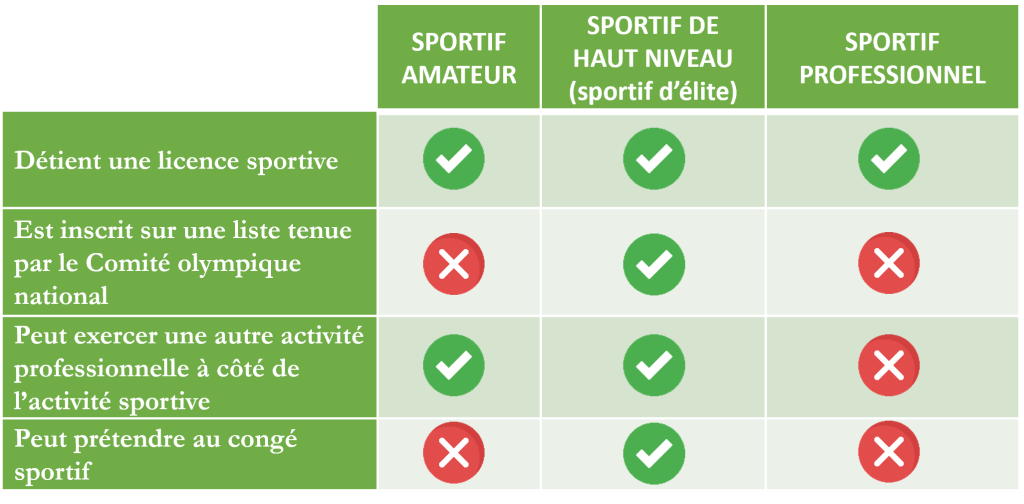
Licensed athletes also have different legal statuses depending on whether they practise sport professionally or not. A distinction must therefore be made between amateur athletes, high-level athletes (referred to as elite athletes in Luxembourg) and professional athletes.
The term elite athlete refers to athletes whose sporting status is officially recognised by a national Olympic committee (the COSL in Luxembourg) and who may therefore benefit from the special sports leave provided for under the amended Law of 3 August 2005 on Sport.
Professional athletes, on the other hand, have entered into an employment contract with their club, which is considered their employer. They therefore benefit from the protective provisions of the Labour Code.
How Are Sports Disputes Resolved?
Another distinctive feature of sports law is that disputes are generally not submitted to ordinary national courts but are almost always resolved through arbitration proceedings, in which one or more appointed arbitrators, acting as experts, deliver a binding decision within a relatively short timeframe.
Arbitration offers numerous advantages given the specific characteristics of sports law, including the need to comply with tight sporting competition schedules and the arbitrators’ understanding of the applicable sporting regulations.
Luxembourg has its own national sports arbitration body, the Luxembourg Commission for Arbitration in Sport (Commission Luxembourgeoise pour l’Arbitrage dans le Sport).
“This body was recently called upon to resolve a dispute between two women’s basketball teams concerning the validity of the final score of a match,” explains Danira Mustafic.
Protecting the Rights and Interests of Athletes
Brucher Thieltgen & Partners advises sports clubs and athletes on the negotiation and drafting of the various contracts they may enter into. The firm also assists and represents them in judicial or arbitration proceedings.
For further information, please do not hesitate to contact:
Nicolas Thieltgen, Managing Partner : nicolas.thieltgen@btplawyers.lu
Philippe Sylvestre, Partner : philippe.sylvestre@btplawyers.lu