


What Are the Options for Winding Up Your Company?
Shareholder disputes, breaches of legal obligations or corporate group restructuring: several circumstances may lead to the dissolution and liquidation of a company. To manage the winding-up of a business effectively, whether voluntary or compulsory, seeking professional legal advice is strongly recommended.
According to STATEC, 573 companies were placed into court-ordered liquidation during the first nine months of 2022. The main entities concerned included holding companies, investment funds and businesses operating in the commercial sector.
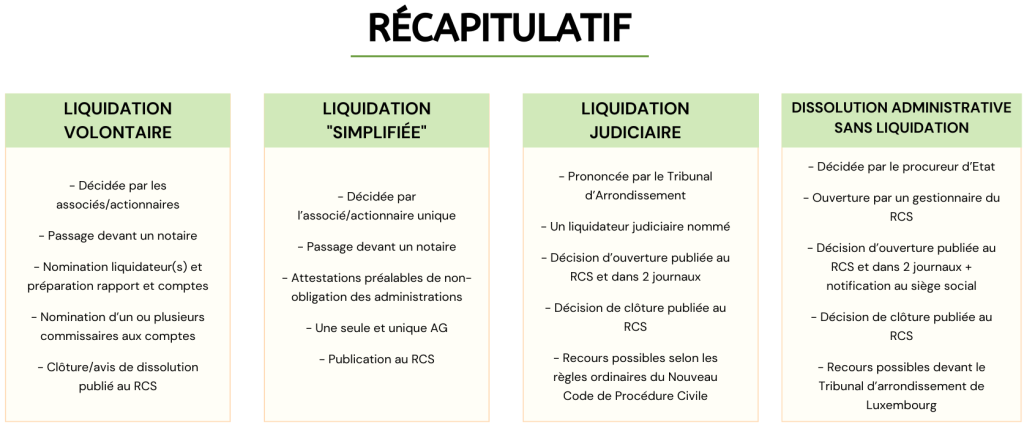
“The District Court sitting in commercial matters may, at the request of the State Prosecutor, order the dissolution and liquidation of a company that has seriously breached criminal law, the provisions of the Commercial Code or the laws governing companies.
Such breaches may include the absence of a known registered office or business address, the resignation of management bodies without replacement, or the failure to file annual accounts with the Luxembourg Trade and Companies Register within seven months following the end of the calendar or financial year,” explains Sami Ben Mahmoud, Senior Associate at Brucher Thieltgen & Partners.
Company directors, or alternatively the general meeting of shareholders where the management body has resigned or is no longer validly constituted, may appoint a legal representative, directly or through an intermediary, to challenge a default judgment within 15 days of its service or notification. In the meantime, they must regularise the company’s situation.
It is also possible to appeal the judgment within 40 days of its service.
In addition to court-ordered liquidation decided by the District Court, the liquidation of a company may also be initiated by its shareholders or partners. Depending on the circumstances, it may take the form of a voluntary or simplified liquidation.
Alternatives to Court-Ordered Liquidation
“One alternative to court-ordered liquidation is the merger by absorption of a company undergoing judicial liquidation into another company belonging to the same group or into a corporate shareholder.
The objective is to transfer all the company’s assets and liabilities without undergoing liquidation. This option remains possible provided that the assets have not yet been distributed and the liquidator agrees.
The District Court sitting in commercial matters must then approve this alternative method of liquidation.”
With a view to protecting the reputation of Luxembourg’s financial centre and combating money laundering and terrorist financing, the legislator introduced a new procedure for administrative dissolution without liquidation, scheduled to enter into force in February 2023.
“A number of companies have ceased carrying out any genuine business activities for several years.
The legislator’s objective is clear: to preserve Luxembourg’s reputation by removing these empty corporate shells, which could potentially be used for illegal purposes, without having to go through the judicial liquidation procedure provided for under company law, which is often longer and more expensive.
Several conditions must be met: the company must have neither assets nor employees and must be carrying out activities contrary to criminal law or seriously breaching the provisions of the Commercial Code or the laws governing commercial companies.
In such circumstances, the decision rests with the State Prosecutor, who instructs the administrator of the Luxembourg Trade and Companies Register to initiate an administrative dissolution procedure without liquidation.”
Acting in the Company’s Best Interests
The liquidation of a company may also be decided voluntarily by its shareholders or partners.
“The reasons for such a decision may include the achievement or disappearance of the company’s corporate purpose, the expiry of its term, disagreements between shareholders, restructuring or other circumstances.
In the context of voluntary liquidation, the directors must convene an extraordinary general meeting before a notary to decide on the company’s dissolution, appoint one or more liquidators and determine the liquidation procedure.
The purpose is to recover and realise the assets of the dissolved company in order to settle its debts and distribute any remaining proceeds to the shareholders.”
To complete this procedure, the liquidation accounts must be approved by the general meeting of shareholders, the liquidation report must be examined, and one or more auditors must be appointed to verify the accuracy of the report and the liquidation accounts prepared by the liquidator.
The decision to close the liquidation, adopted at a subsequent ordinary general meeting, is then published in the Luxembourg Trade and Companies Register.
Where all shares are held by a single shareholder, it may be more advantageous to opt for a so-called “simplified” liquidation.
“In addition to the requirement that all shares be held by a sole shareholder, the company must first obtain certificates from the Joint Social Security Centre (CCSS), the Luxembourg Inland Revenue (Administration des contributions directes) and the Registration Duties, Estates and VAT Authority (Administration de l’enregistrement et des domaines), confirming that it is up to date with its obligations.
The company’s accounts must also have been approved and filed within the statutory deadlines, and the decision must be formalised before a notary.”
Such a procedure results in the transfer of all the company’s assets and liabilities to its sole shareholder.
To determine which procedure is most appropriate, a case-by-case assessment must be carried out by a legal professional.
“Our firm advises clients on the most suitable options, the conditions to be fulfilled, the measures to be implemented and the drafting of the necessary legal documents, ensuring that the liquidation is carried out in the company’s best interests.
We also assist clients with appeals and other legal remedies,” concludes Sami Ben Mahmoud.
For Further Information, please do not hesitate to contact:
Nicolas Bernardy, Partner : nicolas.bernardy@btplawyers.lu