

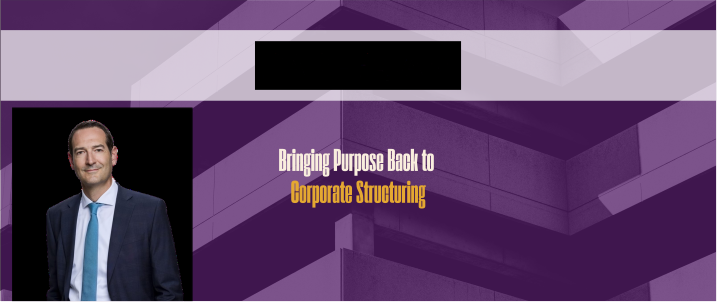
Bringing Purpose Back to Corporate Structuring
Corporate structuring is evolving towards greater efficiency. Today’s business leaders are increasingly seeking to establish more transparent structures that facilitate joint projects and anticipate future developments, such as fundraising or company disposals.
Traditionally, Luxembourg has been home to numerous holding companies. In other words, companies with limited activities whose sole purpose was to hold investments abroad. These companies were themselves owned by other foreign entities, often for tax-related reasons.
“We are currently moving away from this model towards genuine corporate governance structures, particularly due to European anti-abuse regulations and the growing emphasis on transparency in Luxembourg.
With the upcoming visit of the Financial Action Task Force (FATF), Luxembourg is determined to rank among the best-performing jurisdictions and remain at the forefront of efforts to combat money laundering and terrorist financing, as well as the identification of the ultimate beneficial owners of the entities concerned,” explains Nicolas Bernardy, Partner at Brucher Thieltgen & Partners.
Greater Involvement from Business Owners and Employees
Today, company incorporations are approached with greater strategic consideration. Major multinational companies seeking to expand their activities in Europe are exploring different jurisdictions to identify the most suitable location for their operations.
If taxation is no longer the primary consideration, what motivates companies to establish new corporate structures?
One of the current trends is towards increasingly sophisticated structuring.
“A company can serve various purposes. In the case of a family business, for example, it can help organise the management and distribution of profits within a family across several generations, while distinguishing between family members who actively participate in managing the business to ensure its long-term sustainability and those who simply wish to receive a share of the profits.”
A similar trend can be observed among shareholders. Some merely wish to contribute capital and receive financial returns, while others seek to become involved in the company and gain greater visibility over its management.
“For example, investment funds investing in these structures are increasingly interested in their governance. They want to understand how the company operates and use the acquisition process as an opportunity to improve its management.”
The days when founders incorporated a company using standard articles of association, which were subsequently amended throughout the company’s lifecycle according to its evolving needs, also appear to be coming to an end.
Entrepreneurs now tend to have a clearer vision of their projects from the outset, supported by detailed business plans covering several years.
Consequently, the articles of association of newly incorporated companies often already provide for several classes of shares or the possibility of issuing beneficiary shares (parts bénéficiaires), in order to anticipate the arrival of future investors and facilitate negotiations.
“We are also witnessing a strong resurgence of stock option plans, allowing employees, key individuals or business partners to acquire shares in the company and become more directly involved in its development.
By contributing to the company’s growth, they are rewarded with the opportunity to participate in annual profits and even receive a share of the sale proceeds if the business is eventually sold.
Modern entrepreneurs have indeed recognised that the development of their activities also depends on the motivation and commitment of their key employees and managers.”
Luxembourg: A Prime Destination for Starting a Business?
In this context, Luxembourg appears to offer a favourable environment for launching new activities at local, European or international level.
“We are receiving an increasing number of enquiries regarding potential relocations, a trend that could gain further momentum.
Several factors could encourage a return to local production, including transport costs, environmental concerns and shortages of various raw materials. These developments could create new opportunities.”
Indeed, Luxembourg has no shortage of advantages.
These include the concentration of expertise within its financial centre, as well as government support for economic development, businesses and innovation.
The wide range of available corporate legal forms also attracts investors, including those from abroad, who can generally find a structure under Luxembourg law that suits their specific projects.
To support these entrepreneurs in Luxembourg, Brucher Thieltgen & Partners provides a comprehensive range of legal services, from company incorporation to liquidation, including ongoing assistance with corporate management.
“We advise clients on the most appropriate legal form for their business, the measures to implement to facilitate its management, and the relationships between the company and its shareholders or among shareholders themselves.
We also have extensive experience in providing ongoing legal assistance to our clients, as well as in preventing and resolving shareholder disputes,” concludes Nicolas Bernardy.
For Further Information, please do not hesitate to contact:
Nicolas Bernardy, Partner :nicolas.bernardy@btplawyers.lu